What is spec-driven development?

Roberto Velasco6 min read
AI-assisted development has moved on from autocomplete to generating complete implementations from natural-language instructions. Along the way, in February 2025, the term vibe coding caught on: describe what you want, look at what comes out and iterate. For exploring an idea or prototyping it is hard to beat, but it falls short when the goal is to build professional, maintainable and verifiable software.
In that case, the conversation with the agent cannot be the only place where the intent behind a change lives. The decisions, nuances and constraints agreed during the session are lost with it, and what remains is code without the why. Reviewing it, validating it or picking it up again a few days later becomes much harder.
How it works
Spec-driven development (SDD) is the response that began to emerge in mid-2025 to solve or mitigate these limitations of vibe coding.
Broadly speaking, it describes workflows that start from a structured functional specification and move forward in stages: clarifying requirements, spotting ambiguities, breaking the problem down, proposing a design and defining the tasks to implement. Only then is code written.
The core idea is not to ask the agent to implement from an informal prompt, but first to turn human intent into a stable, reviewable and versioned artefact that serves as the basis for design, tests, implementation and validation.
What is more, a specification that describes what the software should do can also be used to generate functional tests or to migrate a legacy system to another stack. For that, it has to reflect the real system at all times: a specification that isn’t updated when the code changes stops being useful.
There are different approaches to implementing spec-driven development, with different levels of maturity and rigour depending on the role given to the specification:
- Spec-first: the specification is written before implementing and used for that specific task.
- Spec-anchored: the specification is kept alongside the code and evolves with it.
- Spec-as-source: the specification is the main artefact and the code is treated as a derivative that is never edited by hand.
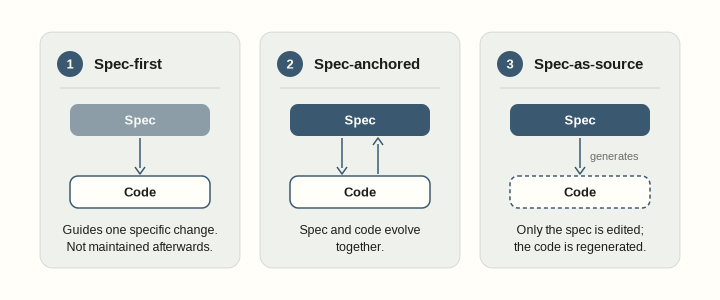
Of the three, by far the most widespread is spec-first, whether with public tools or in-house solutions: a way of structuring the intent of what is to be built in order to get better code. Keeping the specification in sync with the code, as the other two levels propose, sounds reasonable on paper, but in practice it is hard to sustain with today’s workflows, and most teams have given up on it.
Which problems spec-driven development tackles
In a previous post we went through the common problems of AI-assisted development. A good number of them have to do with what happens before any code is written, and that is where SDD helps:
- Unclear goals and the bias towards agreeing with the user. An explicit requirements phase forces ambiguities and assumptions to surface before the agent diligently implements them.
- The bias towards finishing the task. Separating specifying, designing and implementing curbs the model’s tendency to jump straight to a plausible solution.
- Poor breakdown of the work. Tasks are defined and reviewed before they are carried out, not on the fly.
- Context degradation and limited memory. Intent lives in files in the repository, not in a session that degrades or gets lost.
- Review and cognitive debt. Reviewing a specification is cheaper than reviewing a large diff, and it records why each change exists.
The tools
Throughout 2025 several tools appeared that put this idea into practice, each with a different approach:
- Kiro (Amazon, July 2025): a development environment that guides the work through three stages, requirements, design and tasks, each with its own document.
- GitHub Spec Kit (September 2025): a set of templates and commands that works with different agents. It follows a similar process but adds a “constitution”: architecture and quality principles that every implementation must respect.
- Tessl: goes further and aims at spec-as-source. The specification is what gets maintained, and the code is generated from it.
Beyond these tools, many organisations are building their own solutions. The details vary, but the underlying idea stays the same: splitting the work into phases, with a reviewable artefact between each one, to model what is to be implemented more formally before the agent writes any code.
What it doesn’t solve
SDD has its limits, and it is worth saying so:
- Bureaucracy for small changes. Going through requirements, design and tasks to fix a bug is out of proportion. It takes judgement to decide when it applies.
- Reviewing a lot of Markdown. The tools generate long specifications. If nobody reads them carefully, we have just moved the review bottleneck somewhere else.
- The agent doesn’t always follow the specification. Having it written down doesn’t guarantee it will be respected; the result still needs verifying.
- Specifications that go out of date. With spec-first this isn’t serious: the specification remains as a record of the decision taken in that change. But if you want to keep it alive, it has to evolve with the code, whether through discipline or through a process that guarantees it. Otherwise it will end up as dead documentation and, worse, misleading documentation.
Conclusions
Spec-driven development has been one of the first serious attempts to bring order to software development in this new AI-based era.
If we look at the essence of the different methods, they all converge on the same thing: structuring the phases of the software development life cycle (SDLC) again, much as has been done historically. That is no coincidence: an agent works better the clearer the intent is.
But SDD focuses on the early phases, on defining well what to build, and it is designed as a collaboration between a person and an agent: someone drives each stage and approves it before moving on to the next. It does not consider processes that run without a person in charge. Today’s needs go further: enforcing the team’s guidelines systematically, verifying the result, keeping security, cost and real usage under control, and doing so consistently across the whole organisation. Specifying intent better is no longer enough.
If vibe coding was improvising and SDD is putting things in order before starting, the next step is to put order into everything that comes after: automating the whole cycle, from idea to production. Some processes should run end to end with no human intervention, and in the rest people should step in only where they add value: deciding and validating. And, above all, learning from every use: the model doesn’t change from one session to the next, but the process can. Every correction, every failure and every review should improve the next run.
That is what we call a software factory, and it is what we will talk about in the next post.