Common problems in AI-assisted development

Roberto Velasco9 min read
Putting an AI agent in the hands of a development team is easy. Getting results that are reliable, maintainable and measurable is not. In this post we go through the problems we usually run into when working with a coding agent.
They don’t all come from the same place, so we have grouped them into four families:
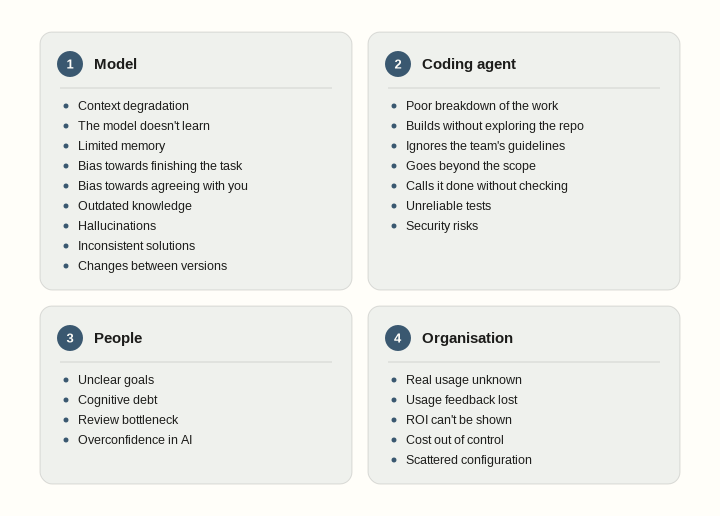
Model limitations
These come with any LLM, whatever tool wraps it.
Context degradation
LLMs work with a limited context window. As a session goes on, it fills up with instructions, decisions, failed attempts, logs, code fragments and intermediate hypotheses.
All that adds noise: the agent can mix approved decisions with discarded ideas, lose sight of important constraints or lean on stale information. And it isn’t only about the maximum window size. Even with larger contexts, too much irrelevant, redundant or contradictory information degrades the quality of its decisions.
The model doesn’t learn
An LLM can adapt its behaviour to what’s in its context, but its parameters don’t change while you use it. Corrections, decisions or knowledge gained in one session do not become part of the model.
Limited, context-dependent memory
LLMs have no persistent memory of the project on their own: what they know in each run comes mainly from the context available. Modern agents add memory through files, summaries or external systems, but that memory depends on the harness and on the relevant information being stored and retrieved correctly.
Bias towards finishing the task
Given a request, the model tends to push towards a plausible answer or implementation rather than stopping to identify uncertainties, ask for clarification and check each assumption.
Bias towards agreeing with the user
When a request contains a wrong premise, a preconceived solution or an incorrect assumption about the system, the model tends to accept it and implement it rather than question it. The result is a correct solution to a badly framed problem, one that can pass compilation, tests and review without anyone spotting the original mistake.
Outdated knowledge
The model’s knowledge can lag behind the current version of a library, framework or API. So it may suggest methods, parameters or patterns that were valid in earlier versions but are now deprecated, have changed or no longer exist.
Hallucinations
LLMs can produce information or code that looks plausible but is wrong. In software development this shows up as methods, parameters, settings, dependencies or behaviours that don’t exist, or as wrong assumptions about how the system works.
Inconsistent decisions and solutions
Faced with the same problem, even with a similar context, an LLM can come up with different solutions. In a project this leads to inconsistencies in architecture, patterns, abstractions or conventions, with less coherence and higher maintenance costs.
Model changes and lack of reproducibility
Models and tools change all the time. A new model version can change its behaviour even when the code, context and instructions stay the same, and a workflow we had already validated starts producing different results.
Coding agent limitations
When we use an LLM as a coding agent, new problems appear. The agent no longer just generates answers: it explores the repository, edits code, runs commands, writes tests and uses external tools. How it does all this, and how we control its autonomy, directly shapes the quality and safety of the result.
Poor breakdown of the work
The agent may split a feature into tasks that are convenient to implement but hard to validate on their own. For example, it may finish entire layers of the application first (all the persistence, to begin with) instead of building small vertical slices (frontend + business logic + data access) that let you check behaviour end to end.
A poor breakdown delays finding problems and raises the risk of integrating several pieces before checking that the solution actually works.
Building without exploring the repository first
The agent may start writing code as soon as it understands the request, without looking closely enough at the existing system. It ends up reimplementing utilities that already existed, ignoring team conventions or solving a problem differently from how the rest of the project does.
Working without the team’s development guidelines
Organisations usually have development guidelines, architecture standards or documented technical decisions, but they tend to live outside the repository and nobody has added them to the agent’s context. The agent then works with the model’s default judgement and ignores conventions the team knows and follows.
Going beyond the scope of the task
The agent may go further than asked: refactoring code that wasn’t part of the request, touching unrelated files or adding abstractions and features nobody asked for. Each change looks reasonable on its own; together they bloat the diff, mix different intentions in a single change and make review and pinning down errors harder.
Calling it done without checking
The agent may consider a task finished as soon as it has a solution that looks valid, without checking that it works. It may skip the build, the tests or the necessary validations, or accept the result too early.
Unreliable tests
When the same agent writes the implementation and its tests, both can share the same wrong assumptions. The same happens if we use that same agent to review or validate its own solution.
Security risks from the agent’s autonomy
A coding agent can read external information, access files, run commands, install dependencies or connect to other systems. That capability brings risks that don’t exist in the same way when an LLM only generates text.
They include prompt injection, excessive permissions, leaked secrets, and non-existent or malicious dependencies (slopsquatting). We can’t assume the model will always detect or resist these situations.
Human factors
Adopting AI agents doesn’t remove human responsibility: it shifts it towards defining the problem, making decisions, supervising and accepting the final result.
Unclear goals
It seems reasonable to assume that whoever asks for something knows exactly what they want, but many requests arrive with ambiguities, implicit assumptions or solutions already decided. Add the model’s tendency to agree, and the agent will diligently build exactly what was asked for, even if it isn’t what’s needed.
Cognitive debt
AI can generate code faster than the team can understand, review and maintain it. Even if it compiles and the tests pass, there may come a point where people lose sight of why a solution exists, what decisions it rests on or what risks it introduces.
Review bottleneck
AI produces changes faster than people can review them, and the bottleneck moves from implementation to validation and acceptance. If everything needs a thorough manual review, the team’s workload grows, and with it the risk of shallow reviews.
Overconfidence in AI
The apparent quality of the answers can lead us to accept AI-generated code, decisions or explanations with less critical thinking than they need. A well-argued solution, or one that comes with tests, can look right without being right.
And this risk grows as trust in, and dependence on, the agent increase.
Organisational factors
Adopting AI also brings challenges at the organisational level.
Not knowing how it’s really used
However carefully we roll out a system, we don’t know whether it’s being used or how. The number of active licences doesn’t distinguish between someone using the agent following the methodology, someone using it only as autocomplete, someone skipping validations or someone using unapproved tools. Without that information you can’t attribute results (improvements or problems) to the use of AI, or spot which teams need support.
Lost usage feedback
The tools produce information about how they’re being used: which tasks fail, what corrections people make to the output, where a session gets abandoned. But that information is usually scattered, isn’t available centrally and often isn’t even stored for later analysis.
As a result, the same mistakes keep happening and the corrections each person makes don’t benefit anyone else.
No way to prove the return on investment
Investment in AI tools is justified by productivity gains that later turn out to be hard to prove. There’s usually no baseline measured before adoption, and the metrics the tools offer by default (active licences, lines generated, suggestions accepted) measure activity, not outcomes.
Without delivery, quality and real-usage data that can be cross-referenced, there’s no way to separate the effect of AI from everything else. Decisions about continuing, expanding or switching tools end up being made without evidence.
Uncontrolled cost and consumption
The cost of a coding agent isn’t fixed like a traditional licence: it depends on token consumption, which varies with the model, the context size, the length of sessions and the agent’s autonomy. The same task can cost several times more depending on how it’s solved.
Usually the organisation only sees the total bill, with no way to attribute it to teams, projects or types of task. Without that breakdown you can’t budget, detect unusual consumption or relate cost to results.
Distributing and updating the configuration
The way of working with the agent comes down to files: instructions, skills, hooks, permissions and connections to external tools. If each person installs and updates them on their own, different versions and local changes soon coexist, and nobody knows which configuration each team is working with.
As a result, outcomes stop being comparable, improvements don’t reach everyone and security controls aren’t applied consistently.
So what now?
None of these problems is a reason not to use AI in software development, but they are a reason not to use it carelessly. Almost all of them have something in common: they aren’t solved by a better model, but by method. Well-managed context, work broken into verifiable steps, team guidelines within the agent’s reach, review designed for changes no person wrote, and data to know what’s really going on.
We’ll cover that in upcoming posts.